

THANK YOU FOR SUBSCRIBING
A featured contribution from Leadership Perspectives: a curated forum reserved for leaders nominated by our subscribers and vetted by our Manufacturing Technology Insights APAC Advisory Board.


New cored wire materials have been developed, bringing a new dimension to the thermal spray coatings of Niobium Carbide Composites. Niobium Carbide (NbC) Composites can now be metallurgically formed and deposited using this cored wire material during the wire arc spray process. The resultant coating has already proved to be an excellent candidate for corrosion, erosion, wear, and anti-slip protection.
Recognition of the potential of NbC Composites has brought with it new approaches and the development of novel feedstock materials. Increased demand of coated and non-coated component longevity, more cost-effective coating solutions, health and safety considerations during coating processes and post coating machining operations, proved a strong motivation to produce a new cored wire for wire arc processing.
Using HSC 10 Chemistry software package, thermodynamic models were generated as a first step in the coating design process, to determine the optimum cored wire feed stock composition. HSC 10 utilized the Gibbs Free energy minimization method to determine the ideal stoichiometries of the cored wire to achieve the desired metal matrix NbC composite coating. An example of a thermodynamic model is shown below in Figure 1. In this case, a Nickel-Chromium metal matrix with NbC composite was generated.
"Recognition of the potential of NbC Composites has brought with it new approaches and the development of novel feedstock material"
With the options of changing the metal matrix between Iron, Nickel, and Aluminum, this NbC composite coating system is versatile, cost efficient and high performing in various lab/field validation test conditions. In the case of Fe based NbC composite coating, the resultant material offered.
1. 6X better than uncoated carbon steel under severe sulfidizing environment.
2. 20% better in erosion testing (ASTM-G76) than other competing products
3. Less fume generation because of the metallurgical reaction during spraying
4. Less toxicity considering the coating contains less Chromium, Nickel, and no Tungsten Carbide or Cobalt.
5. Broad functionality of applications – Wire Arc, Laser Cladding/Laser – Direct Energy Deposition (DED), Plasma Transferred Arc etc.
Excellent ductility – The coating can be bent 25 degrees without cracking, which is ~ 25% better than other competing products in this segment.
An example of an Aluminum base NbC Composite coating microstructure and post bend test pictures are shown in Figure 2 and 3.
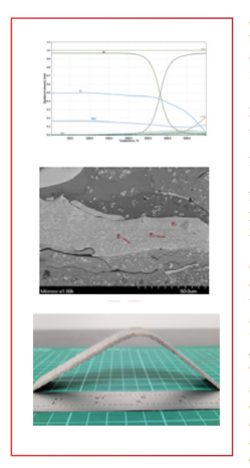 The Aluminum base NbC composite (Microstructure shown in Figure 2) offers excellent ductility, and it can be bent in excess of 65 degrees without any cracking. The average hardness of this composite was ~ 750HV (61 HRC), which is approximately 4X greater than Stainless Steel 304 material. This coating protects any steel substrate against saltwater corrosion. All these coating features make this material an excellent candidate for marine, offshore, and Navy flight deck applications against corrosion, wear and anti-slip issues.
Though this material was tested and validated for specific component applications, this NbC composite could extend its application in broader Industrial, Metals and Mining, Pulp and Paper, Oil and Gas, Power, Wind, Hydro, and other Government agencies like DOD, DOE etc. uses.
Twin-arc and cored wire products have been in the market for many years and continuous innovations like this newly developed NbC composite coatings system can revive components making them longer lasting and more sustainable, while maintaining cost effectiveness, environmental friendliness and excellent use properties.

Manufacturing Technology Insights Weekly Brief
Be first to read the latest tech news, Industry Leader's Insights, and CIO interviews of medium and large enterprises exclusively from Manufacturing Technology Insights
