

THANK YOU FOR SUBSCRIBING
A featured contribution from Leadership Perspectives: a curated forum reserved for leaders nominated by our subscribers and vetted by our Manufacturing Technology Insights APAC Advisory Board.


I have seen manufacturing in America since 1980, about 40 years. It was a great transition time when other World War II-affected economies began to reassert themselves, of course with the help of American experts and resources, but still with their work ethics, national competencies, motivations, and growing economy in the USA.
Post World War era started to shape in the 1950s. American superiority in manufacturing in World War was pushed into the 50s, driven through the 60s, and started to stumble in the 70s. There was a time when anything made in the US was considered the best in the free world. Our cars were giants, bigger cars were considered the better, car repairs or services were common, and auto-mechanics were in demand. In the 1960s and 70s, manufacturing was accelerated through innovations, especially in the electronics industry.
In the early eighties, semiconductors were a growing industry. Motorola, MOSFET, Texas Instruments, Intel, AMD, and Fairchild were key corporations. It was the infancy of the large-scale integration (LSI) chips industry. I worked as a designated engineer to support production yields of 1K, 4K, and 16K memory chips. Our wafer yields were about 50 percent, we had yield losses due to inconsistency in manufacturing. After trying to improve for three years, we gave up and decided to pursue new designs (64K) and transfer our manufacturing of older chips to our sister plant in Japan. I, being the newer kid on the block, was asked to support the transfer for yields. I still remember vividly that our yields kept going up at the 450 angle trend until they crossed the mid-90 percentage.
At that time, there was a perception of Japan dumping chips in the US at half the price, but I just learned that their yields were probably twice as good then. How was it all achieved? There was no secret, no shortcut was taken, and thorough experiments and analyses were conducted to drive improvement. Looking back, we were more interested in doing exciting work on new designs, while old designs never achieved success or their designed performance in manufacturing. That was the beginning of outsourcing, first within multinationals followed by outsourcing to suppliers for poor quality and the lower cost of labor. That grew in scope and eventually led to global supply chains without realizing that sometimes the total cost of items outsourced is higher than the local cost. Customer responsiveness, disruptions, and recent logistics costs have unsettled the global supply chains. In addition, diminishing experience and knowledge in manufacturing started to reflect in limitations of and innovations in designs. Demand for restoring or bringing manufacturing back to has been growing for many years.
Recent manufacturing studies show that U.S. manufacturing is still ranked number 2 in the world after that of China. Our leading industries are gas and petroleum products, light trucks, and pharmaceuticals. Top industries shooting for reshoring include transportation equipment, computer electronics production, and electrical appliances and components. It is hard to understand what is being brought back for reshoring. Irrespective of what we will be manufacturing we must remember what led us to outsource. The most important cause was our inability to produce high-quality products. We must accept it and take the necessary steps to ensure “Made in the USA’ is the best in the world again.
In the 2000s, I was inspired to write books on topics that would add value to a business. Being a Quality professional, one of the questions that I wanted to answer was why American manufacturing suffered. As I started to think about it, I realized that the poor-quality phenomenon was not limited to a specific industry. It was prevalent across all industries implying that it must have taken many years to ingrain such questionable quality mindset. This led me to study quality principles from the early industrialization era to the current practices.
“Irrespective of what we will be manufacturing we must remember what led us to outsource. The most important cause was our inability to produce high-quality products”
The 1920s can be recognized as the period of industrialization following Frederick Taylor’s work and the dawn of the field of quality. Walter Shewhart of Bell Laboratories invented the concept of control charts, and H.F. Dodge and H.G. Romig developed acceptance-sampling methods. The 20s also saw the United States enjoying post-war prosperity as one of the victors of World War I. In those days, quality methods were considered trade secrets because they provided a competitive edge.
After World War II, helping Japan rebuild its economy and infrastructure, we send our quality expert Dr. Ed Deming to Japan for guidance. Based on the inventor of SPC (Statistical Process Control), Dr. Shewhart’s Out of Control Action Plans in the 1920s, Deming developed PDCA (Plan, Do, Check, Act, shown in Figure 1. However, the PDCA was developed for product control that depended upon Planning the quantity, Doing the production, Checking against the acceptable limits, and Acting to remedy the defects. This produced an ‘acceptable’ product. Deming tried to change his model to Plan, Do, Study, and Act, however, people stuck to PDCA, the path of least resistance. A check is easier than studying a problem.
Since then PDCA had become the norm to build and inspect the product and take corrective actions. In response, experts around the world have developed tools to support PDCA implementation. Such as Dr. Ishikawa developed a Fishbone diagram (4Ms), Dr. Taguchi developed Target driven designs, Dr. Juran focused on excellence in execution, and Dr. Deming emphasized using statistics to reduce variation. The original brain behind the work was Dr. Shewhart who invented statistical process control for ensuring 100% acceptable product in the normal distribution, where most of the product would be close to the target designs. To conclude my work, I integrated the work of these five Gurus into a 4P (Prepare, Perform, Perfect, and Progress) model to create and achieve excellence in manufacturing, shown in Figure 2. Instead of saying ‘just do it’ we need to emphasize ‘do it well.’ Excellence begins with defining the target and preparation or process set up to achieve the target performance. Results showed that the defect rate decreased from high percentages (tens of thousands) to a few defects in a million.
In my current job in the packaging industry, our local manufacturers emphasized that industry practice was about a 2 percent acceptable defect rate. Then during my visit to China almost all manufacturing shops have a visible company goal of ‘zero defects’. It is a state of mind that we need to adapt to ‘zero’ defects or almost perfect products. As someone said, planning for a 2 percent acceptable defect rate versus planning for a ‘zero’ defect requires a different state of mind.
As we depend upon global supply chains, our responsiveness to customers is adversely affected. Thus, the primary reasons for reshoring are the proximity to customers and responsiveness. People are realizing that the benefits of onshore production outweigh the higher labor cost, besides ongoing geo-political instabilities.
Through outsourcing for the last 40 years, we have learned to focus on the total life-cycle cost of an item, customer responsiveness, visible controls, and loss of competencies. We have realized that we need to be a country of tangible value creation rather than secondary value creation. No nation can achieve greatness without creating value internally, or manufacturing onshore. However, we must ensure as a society that we not only expect excellence but produce excellence to meet our needs. Acceptable, Okay, or Tolerable products are not globally competitive and cost more to make. We must learn how to achieve excellence in schools, a prerequisite to producing excellence in the industry.
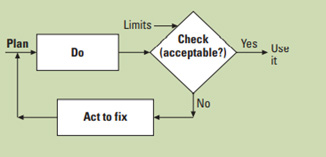
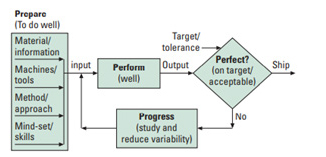
Figure 2. The new 4P, an improved PDCA, model for achieving excellence
Bibliography:
1.Gupta, Praveen, Beyond PDCA – A New Process Management Model, pg 45-52, Quality Progress, ASQ, July 2006.
2.Spiegel, Rob, US Manufacturing Roars Back in 2022, Design News/ Electronic News, Oct 2022 .

Manufacturing Technology Insights Weekly Brief
Be first to read the latest tech news, Industry Leader's Insights, and CIO interviews of medium and large enterprises exclusively from Manufacturing Technology Insights
