

THANK YOU FOR SUBSCRIBING
A featured contribution from Leadership Perspectives: a curated forum reserved for leaders nominated by our subscribers and vetted by our Manufacturing Technology Insights APAC Advisory Board.

Noe Quinones is an experienced Product Manager with a demonstrated history of working in the industrial automation industry. He is skilled in AC/DC controllers, Automation, Conveyors, Linear Motion, Microsoft Dynamic CRM, Management, AutoCAD, Budgeting, Microsoft Excel, Customer Service, Technical Support, and Power Transmission. Quinones is a strong engineering professional with a Bachelor of Science (BS) focused on Electrical Engineering Technologies/Technicians from Northern Illinois University.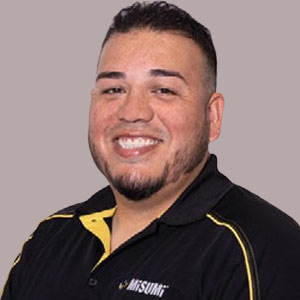
Noe Quinones
What Are The Roles And Responsibilities That You Serve At Your Organization?
I am a Senior Product Manager at MISUMI and I manage the Motion and Unit department. Our team oversees the production and manufacturing of motion products including Actuators, Linear Guides, and Conveyors, among others that are used in markets like electric vehicle (EV) assembly and automation, semiconductors, and warehouse automation.
I also manage product made in our Dayton, Ohio manufacturing plant that is focused on Linear Shafts, Rotary Shafts, and Posts/Standoffs.
Along with managing products, I also keep a close eye on customer satisfaction. We follow a Quality, Cost, and Time (QCT) business model to make that happen. We ensure that our products are of the highest quality and are cost-effective while having some of the best lead times possible.
Linear Shafts, Rotary Shafts, and Posts are among our best-selling products and our local team in Dayton ensure that production happens on time while adhering to the highest quality that the customers expect from us.
Can You Talk More About The Configuration Solution, Its Value To Customers, And Its Uniqueness In The Manufacturing Space?
We have three kinds of customers. The ones who want an off[1]the-shelf product, those who want a configurable component, and those who want a fully custom product.
MISUMI is unique as we are both a manufacturer and a distributor. We do offer custom and off-the-shelf products, but MISUMI is more known for our configuration capabilities. Customers can easily configure a part’s materials, dimensions, features, and finishes to meet their project needs. Once ordered, they can be delivered as quickly as two days.
"There are several markets within the Industrial Automation industry that are rapidly growing, from EV to warehouse automation, which is why it’s crucial to have a manufacturing partner that focuses on configurability as a fast and cost-effective solution"
To configure a component, customers can go to our website, find the product they are looking for, and make the modifications they want on the website. They can download a 3D computer-aided design (CAD) and see how it looks on our website. After selecting the required configurable component, the customer can see the lead time breakdown with prices based on the needed quantities.
One of the benefits of offering configurable components, and with MISUMI being a global company, is that our customers get a part number that is global. Meaning that they can use that part number in any MISUMI worldwide and they will still get their specific part as they had configured with the same quality standards as the first one they got.
How Do You Prevent Corrosion In Your Products?
Aside from off-the-shelf products, most of our products don’t sit on the shelf for days at a time since they are made-to-order and produced only when our customers place an order. However, we do take necessary precautions because some parts are shipped from overseas.
To prevent rust, we coat our products in multiple layers of anti-rust oil and seal them properly while packaging, so they remain rust-free even if customers don’t use them right after receiving them.
We also offer different anti-rust coating for different materials, which helps in further preventing rust when customers are using our products. For instance, we have conducted a lot of testing —like sea salt testing — to find that black oxide offers the highest corrosion resistance for ferrous materials while offering a better surface finish on the products. We offer black oxide for our carbon steel materials.
We also use hard chrome or stainless steel as alternatives. An anti-rust oil, on the other, prevents the deterioration of products while being shipped to customers by air, water, or road.
What Are Some Of The Biggest Challenges Facing The Industrial Automation Industry Today?
There are several markets within the Industrial Automation industry that are rapidly growing, from EV to semiconductors, to warehouse automation, which is why it’s crucial to have a manufacturing partner that focuses on configurability as a fast and cost-effective solution.
Some of the biggest challenges the market is facing include labor and material shortages, plus getting finished products procured on time. As companies are moving towards automation, these challenges become even harder to face.
But the way that MISUMI is helping is by offering the flexibility needed to get high-quality components for assembly, machinery, equipment, and other design projects delivered on time in the most cost-effective way. For example, most of our components don’t have to be touched or modified at the customer’s location, since they are already finished before delivery.
Our goal is to help support these fast-growing markets, despite these challenges, and we do this by consistently improving our capabilities.
What Would Be Your Piece Of Advice To Fellow Peers And Aspiring Professionals In The Industry?
My piece of advice would be to focus on the growing markets like EV, warehouse automation, and semiconductors and understand what and how they are conducting their business. Also, product managers should take part in the functioning of different teams to know how the entire product lifecycle works. That way, one can be a better asset to the company as a whole and not just be a conventional product manager.

Manufacturing Technology Insights Weekly Brief
Be first to read the latest tech news, Industry Leader's Insights, and CIO interviews of medium and large enterprises exclusively from Manufacturing Technology Insights
