

THANK YOU FOR SUBSCRIBING
A featured contribution from Leadership Perspectives: a curated forum reserved for leaders nominated by our subscribers and vetted by our Manufacturing Technology Insights APAC Advisory Board.


Tackling the reduction of carbon emissions is becoming one of this generation’s biggest engineering challenges. Over the past decade, corporations have developed an array of strategies that seek to identify the biggest sources of emissions within their industrial operations and are developing solutions that target those sources. While this is a logical approach to emissions reductions, there may be limitations on how much impact can ultimately be achieved under current business models.
Looking for emissions reductions based upon existing sources establishes an unnecessary constraint on the search for improvement. Imagine if the speed of transportation in the days of horse drawn carriage were limited to merely improving the performance of horses and carriages. We never would have seen the development of the car – a mode of transport that is superior in more than just speed, but distance, comfort, and utility.
Looking Beyond
If we seek to transform businesses and supply chains such that they achieve – and ultimately exceed –Net Zero, we must look beyond evolutionary changes in existing models toward revolutionary changes that challenge our understanding of the value chain.
Many of the Net Zero strategies that are being developed today are aimed at 2030, 2040, and 2050. In those time horizons, there is no reason to believe that production technologies, products, or business models will resemble what exists now. As such, emissions strategies should be more ambitious, seeking more than mere improvements in energy efficiency or transitions to renewable energy sources.
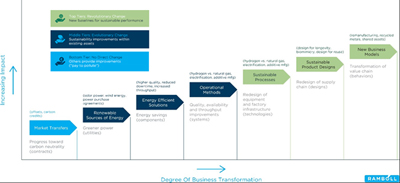
“While significant emissions reductions can be achieved at the lower tiers of the Net Zero Impact Model, the most impactful strategies must consider the top three tiers.”
 What we need is a more comprehensive approach to Net Zero strategy development, one that balances short-term emissions reductions and long-term disruptive innovations. Developing more ambitious strategies must be a collaborative effort in which we engage more than business strategists and sustainability leaders. We need to also tap the creativity of a broader segment of our business innovators including those in operations, sourcing, facilities, product design, R&D, and engineering.
Some of the best strategic opportunities for emissions reductions may even come from outside of our organizations, through engagement of suppliers and customers.
One way to encourage this shift in thinking is to recognize the relative, potential impact on emissions from different activities in the manufacturing value chain. Many of the near-term actions being incorporated into Net Zero strategies require little transformation of an operation, product design or business model. For instance, incorporating renewable sources of electricity or making changes to existing machinery to achieve energy efficiency can occur with little disruption to operations. More significant impact is available by changing materials within a product design or introducing completely new manufacturing technologies that avoid fossil fuel use altogether.
The following Net Zero Impact Model shows the relative value of various business activities in achieving significant emissions reductions.

Manufacturing Technology Insights Weekly Brief
Be first to read the latest tech news, Industry Leader's Insights, and CIO interviews of medium and large enterprises exclusively from Manufacturing Technology Insights
