

THANK YOU FOR SUBSCRIBING
A featured contribution from Leadership Perspectives: a curated forum reserved for leaders nominated by our subscribers and vetted by our Manufacturing Technology Insights APAC Advisory Board.


It is believed the pandemic has accelerated digital transformation. Traditional enterprises faced the brunt as lock downs ensued and people were not able to physically engage. Many shuttered. It was a harsh wake up call for enterprises that were slow to adopt digital transformation. And yet, many have thrived with digital solutions in place to brave the unexpected. For these enterprises the question is how to sustain solutions we have, and innovate on what we do not? What are our options to stay ahead where customers’ needs are unique in this digital economy?
Bimodal Information Technology
Digital solutions can be simply off-the-shelf or in-house developed. Let’s have the best of both. Enterprises should embrace the bimodal IT model. One mode runs core processes, and another for innovation.
Mode 1 is our day-to-day digital operation/business processes, stable and predictable. This mode mostly comprises of industry established off-the-shelf enterprise digital solutions like enterprise resource planning (ERP), manufacturing execution system (MES), and other control systems.
Mode 2 is where we explore and innovate on top of Mode 1, agile and fast. New custom digital solutions, integration between core systems of Mode 1 and cloud services, and the adoption of emerging technologies are among the scope of Mode 2.
Realizing Mode 2
Digitalization drives the need for digital solutions. Companies weigh between ready-made and customized solutions. Ready- made does not fit every scenario, while customized is too resource intensive.
The classic software development life cycle methodology of Waterfall, for example, is highly structured. However, its rigidity and extended solution time to market makes it unfeasible. Agile methodology has since taken precedence. Small iterations, close collaboration, and high adaptability define Mode 2.
To set up a team and infrastructure for Mode 2 is challenging, especially for smaller companies relying on ready-made solutions trying to be agile. On the other hand, larger companies are more focused on streamlining existing digital solution teams, improving efficiency, quality, and sustainability of solution deliveries.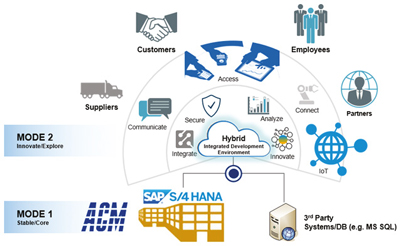
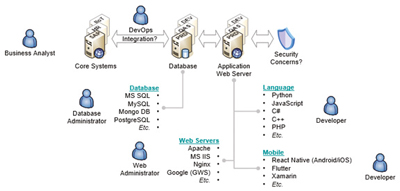
The challenges faced by companies regardless of size are wide range of skill-sets to consider(Figure 2), large developer/technical teams to manage, lack of available and appropriately skilled workforce in the market, difficult to onboard new developers, loss of project continuity due to lack or incomplete documentations, complicated backend systems, complicated integration between systems (legacy and new), concerns on security and compliance, not responsive enough to business changes, the list goes on.
Automating Solution Development
What if the challenges that hinder innovation and backend technicalities could be hidden and automated? What if we could redirect our resources to streamline business processes and meet customers’ needs instead? Picture an agile solution development environment with a team comprising of skilled developers, active stakeholder collaborations, creating highly adaptable solutions.
"Low-code (and no-code) is here to stay, enabling enduser to accelerate solution development. When we are enabled, we see opportunities in otherwise challenging situations. Let our imagination soar and start innovating."
Low-code platforms have been in the market for over 20 years. They have matured over the last five years to a point where industry players recognize their potential and value.
Low-code technology embeds AI and machine learning within its framework. The public availability of generative artificial intelligence over the past months created much buzz and realization. The value, generative AI could contribute to low-code, is expected to be huge.
 Things To Look Out For In A Low-Code Platform
At high level, these should be in your review when considering lowcode development technology. The key word is “simplification”.
1. Single and comprehensive IDE (Integrated Development Environment) application.
a. All you need for your solution development from integration, data, logic, user interface, and workflow, can be defined in a single development environment.
b. Real-time solution quality and security advisories during development ensure robust solution creation from the get-go.
c. Marketplace for reusable, open code modules, connectors, UI components, and business solutions help accelerate s olution delivery.
2. An extension of your solution development team and IT infrastructure.
a. Flexibility to deploy development platform on premise or on cloud.
b. Customizable (on premise) for end user, or commercial solution development.
c. Single solution builds cross-platform delivery (omni-channel).
3. Generate industry standard assets, non-proprietary stack (no lock-in).
a. Industry standard code.
b. Industry standard database.
4. Comprehensive and simplified billing model (transparent, no hidden costs).
Start Innovating
Low-code (and no-code) is here to stay, enabling end-user to accelerate solution development. When we are enabled, we see opportunities in otherwise challenging situations. Let our imagination soar and start innovating.

Manufacturing Technology Insights Weekly Brief
Be first to read the latest tech news, Industry Leader's Insights, and CIO interviews of medium and large enterprises exclusively from Manufacturing Technology Insights
