George Triantafyllou (Senior Project Manager & MODAPTO Project Coordinator) &
Katerina Kaplani (Project Manager),
Athens Technology Center
Modern manufacturing is under pressure. From global supply chain disruptions to rising demand for customisation and sustainability, factories today must be more agile than ever. The ability to pivot quickly—without sacrificing efficiency or quality—is now a competitive necessity for responding rapidly to changing consumer and societal needs, addressing mass customisation and effectively handling supply chain or other disruptions.
Enter MODAPTO
Funded by the European Union’s Horizon Europe 2021-2027 programme, MODAPTO is rethinking how production systems are designed, reconfigured and operated. Its mission? To address industries belonging in the modular/reconfigurable manufacturing category and empower manufacturers with a more innovative, faster and more sustainable approach to flexible manufacturing—using modular technologies powered by digital twins and standardised communication frameworks. Simultaneously, it offers the benefits of global production view by enabling collective intelligence within modular production schemes for practical module and production line design, reconfiguration and decision support.
The vision: Intelligent Systems, Seamless Integration
A key concept lies at the core of the MODAPTO project team’s work: where applicable, future factories could be transformed to replace rigid, monolithic production lines with easily reconfigurable modular units, made intelligent through digitalisation. In other words, create modular setups for factories that can be easily adapted and their lines reassembled.
Each module—whether it’s a robot arm, a conveyor or a packaging unit—is equipped with or paired to a digital twin, a virtual model that mirrors its real-world counterpart. This digital replica connects to an intelligent system that enables real-time monitoring, (co-) optimisation, self-awareness & predictive maintenance, performance (co-)simulation and sustainability analytics. The project explores how this pairing can improve flexibility and responsiveness on the shop floor.
To ensure different modules can work together, MODAPTO enforces compatibility via an interoperability framework built on developed services and based on industrial standards (using the Asset Administration Shell (AAS). This enables seamless coordination between components, across factory systems and strengthens module-to-module cooperation.
Two Pillars of Innovation
MODAPTO’s research and development activities are structured around two technological pillars:
1. Distributed Intelligence via Interoperable Digital Twins
The project investigates Digital Twins’ support on:
• Simulation/optimisation.
• Module self-awareness.
• Sustainability analytics.
These tools, developed within the project, aim to help manufacturers explore the benefits of modularity, assess reconfiguration strategies and reduce risk when adapting or expanding their production systems.
2. A Modular Production Framework and Toolkit
MODAPTO has designed and validated a fully functional toolkit to support:
• High-level production design and line reconfiguration.
• (Co-)simulation/optimisation and decision support tools.
• Predictive maintenance.
• Virtual commissioning (testing systems before implementation).
• Energy insights for sustainability evaluation.
By implementing digital twins compliant with the AAS standard, MODAPTO enables communication and coordination between modules, thereby supporting the design and reconfiguration of modules and production lines. This allows for flexible rearrangement by introducing, removing, altering or replacing parts or process steps.
Real-world Pilots: Demonstrating Potential Impact
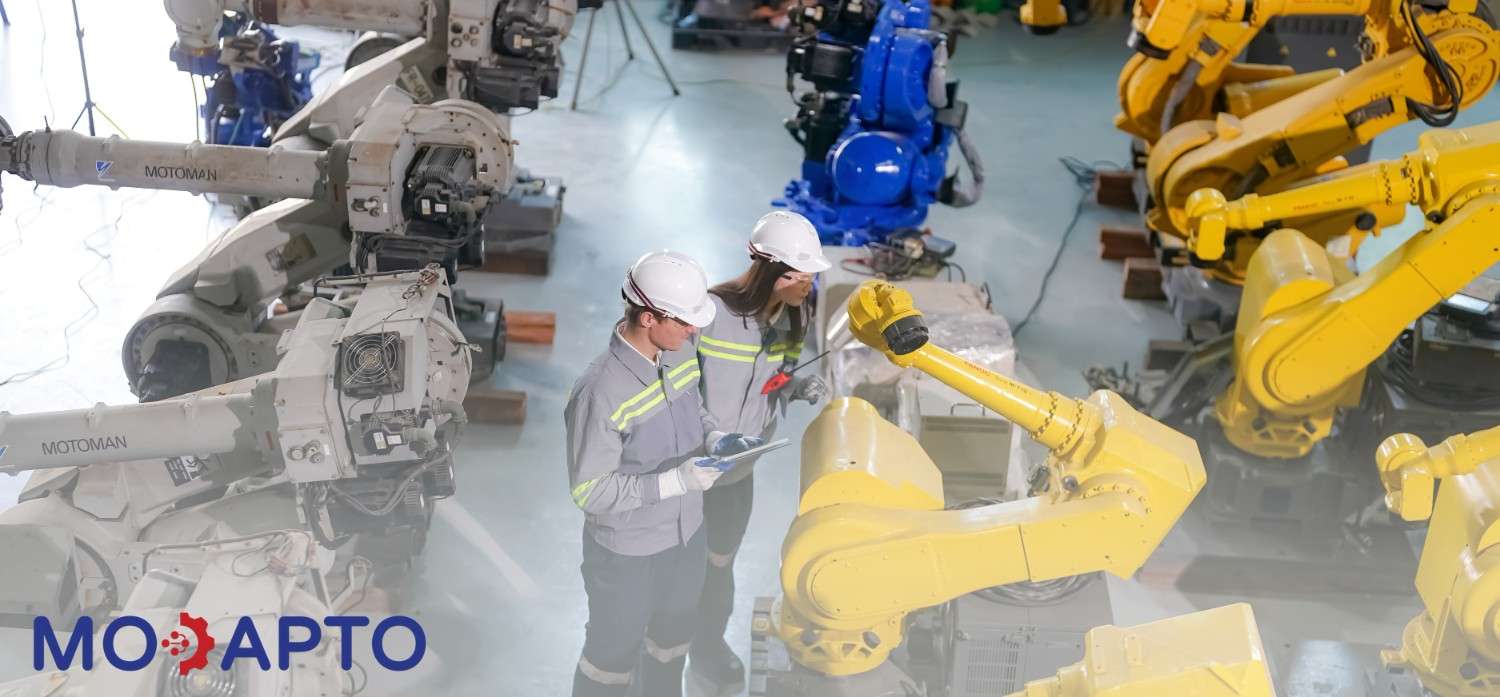
MODAPTO’s concepts have been tested in three industrial pilot use cases, showcasing the versatility of the approach across different sectors.
Within the framework of the project, they explored four robotic setups using various joining technologies. MODAPTO's framework allowed FFT to:
• Evaluate different robot configurations based on performance and sustainability.
• Simulate operations virtually.
• Reduce energy use and carbon emissions.
Demonstrated potential: Enhanced robotic systems with optimised movement, energy efficiency and improved sustainability analytics.
SEW-Eurodrive (Drive & Automation Solutions)
SEW is using MODAPTO to unlock hidden potential in production lines and analyse production bottlenecks. Self-awareness and predictive maintenance strategies enabled the company to:
• Simulate and optimise order processing;
• Improve line balancing;
• Early identify end-of-life components.
Demonstrated potential: Increased efficiency through dynamic scheduling and predictive maintenance insights.
CRF & Iltar-Italbox (Automotive Supply Chain)
Working in the automotive industry, CRF and its partner, Iltar-Italbox, developed smart kit-holders that include tracking and damage detection sensors. Robots use these holders to load semi-finished products more efficiently.
Demonstrated potential: A 25 per cent faster filling process, improved insights on damaged equipment detection and geolocation tracking.
Why this matters: Agility, Sustainability and Industrial Scalability
The project’s team addressed some pressing challenges in modern manufacturing. Through its research, the project demonstrates how modular, digitalised production systems could:
• Respond quickly to rapid demand changes and supply chain disruptions.
• Reduce environmental impact through energy optimization.
• Improve operational decision-making via real-time insights.
• Enable customisation down to a single lot batch size.
• Support transferability and scalability across intra-factory infrastructure.
These outcomes are particularly relevant for Small and Medium-sized Enterprises (SMEs), where agility and cost-efficiency are crucial.
A Pathway Toward More Innovative Manufacturing
Beyond technology development, MODAPTO also explores broader impacts, including:
• Sustainable business models supporting modular production.
• Training frameworks to upskill workers and transfer know-how.
• Cross-sector applications, helping industries adopt flexible, intelligent systems based on common standards.
By combining digital transformation with modularity, MODAPTO contributes to a vision of more resilient, energy-conscious and adaptable manufacturing.
Conclusion: Rethinking What a Factory Can Be
MODAPTO shows that the factory of the future shouldn't be rebuilt from scratch. Instead, it can evolve one intelligent module at a time.
As global manufacturing shifts towards agile, data-driven models, the findings and technologies developed within MODAPTO offer valuable guidance for companies seeking to stay ahead.
To learn more about MODAPTO, visit: www.modapto.eu
About the project
The MODAPTO project was coordinated by Athens Technology Centre (ATC) in Greece and brought together a diverse consortium of leading research institutions, universities, technology providers and industrial partners from across Europe, namely:
• Fraunhofer Gesellschaft (Germany)
• Université de Lorraine (France)
• University of Piraeus Research Centre (UPRC) (Greece)
• Athens University of Economics and Business (AUEB) (Greece)
• EKS InTec GmbH (Germany)
• BOC Products & Services (Austria)
• AEGIS IT Research GmbH (Germany)
• Lithuanian Innovation Centre (LIC) (Lithuania)
• FFT Produktionssysteme GmbH & Co. KG (Germany)
• SEW USOCOME (France)
• Centro Ricerche Fiat (CRF) (Italy)
• ILTAR-BOX Industrie Riunite S.p.A. (Italy)
Together, the MODAPTO partners combine deep expertise in manufacturing, digital technologies, automation and innovation management. Their collaborative research is helping to shape a new generation of intelligent, modular and flexible manufacturing systems for Europe and beyond.
This project has received funding from the European Union under grant agreement No. 101091996.