

THANK YOU FOR SUBSCRIBING


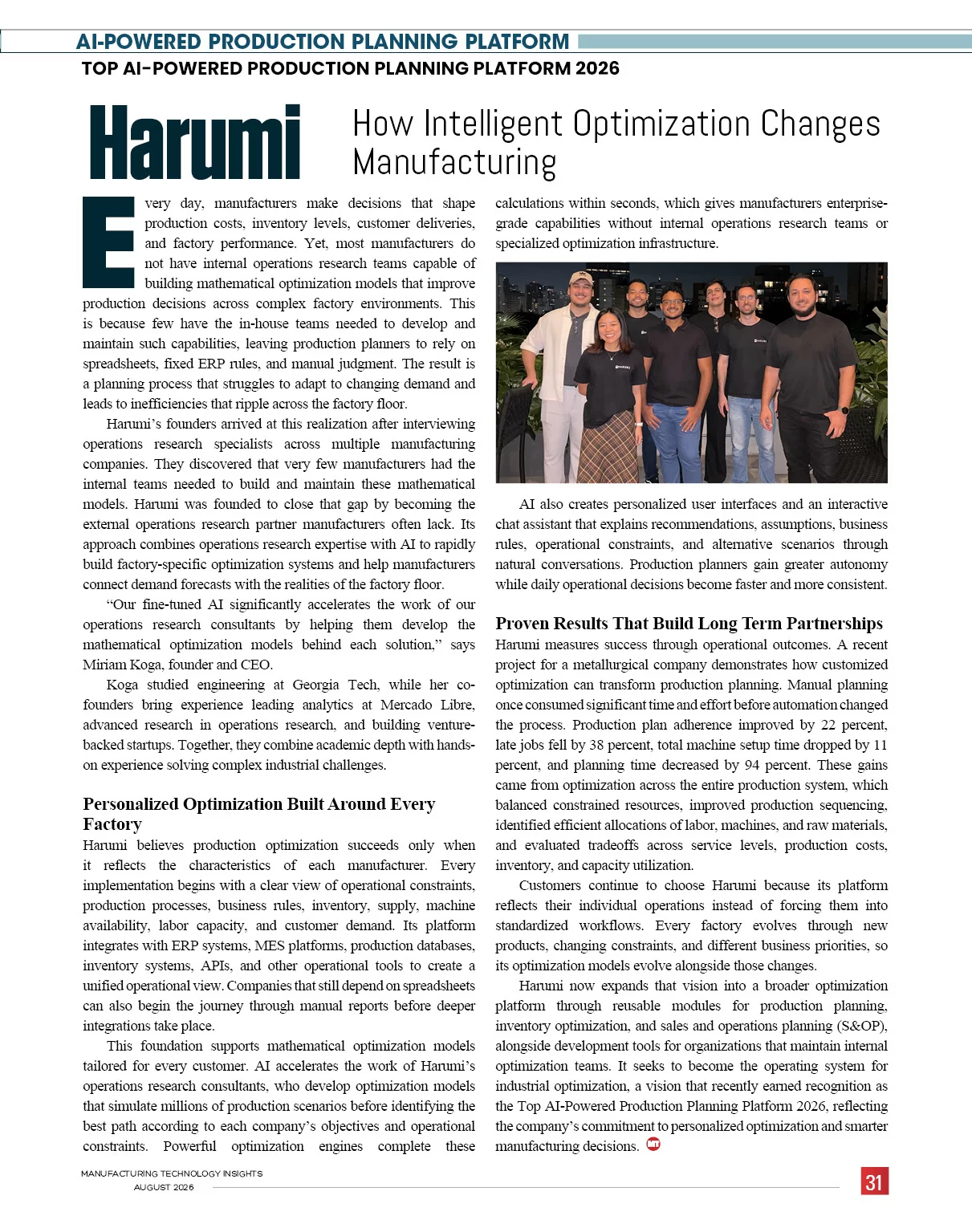
Harumi's founders arrived at this realization after interviewing operations research specialists across multiple manufacturing companies. They discovered that very few manufacturers had the internal teams needed to build and maintain these mathematical models. Harumi was founded to close that gap by becoming the external operations research partner manufacturers often lack. Its approach combines operations research expertise with AI to rapidly build factory-specific optimization systems and help manufacturers connect demand forecasts with the realities of the factory floor.
 “Our fine-tuned AI significantly accelerates the work of our operations research consultants by helping them develop the mathematical optimization models behind each solution,” says Miriam Koga, founder and CEO.
Koga studied engineering at Georgia Tech, while her co-founders bring experience leading analytics at Mercado Libre, advanced research in operations research, and building venture-backed startups. Together, they combine academic depth with hands-on experience solving complex industrial challenges.
Personalized Optimization Built Around Every Factory
Harumi believes production optimization succeeds only when it reflects the characteristics of each manufacturer. Every implementation begins with a clear view of operational constraints, production processes, business rules, inventory, supply, machine availability, labor capacity, and customer demand. Its platform integrates with ERP systems, MES platforms, production databases, inventory systems, APIs, and other operational tools to create a unified operational view. Companies that still depend on spreadsheets can also begin the journey through manual reports before deeper integrations take place.
AI also creates personalized user interfaces and an interactive chat assistant that explains recommendations, assumptions, business rules, operational constraints, and alternative scenarios through natural conversations. Production planners gain greater autonomy while daily operational decisions become faster and more consistent.
Proven Results That Build Long Term Partnerships
Harumi measures success through operational outcomes. A recent project for a metallurgical company demonstrates how customized optimization can transform production planning. Manual planning once consumed significant time and effort before automation changed the process. Production plan adherence improved by 22 percent, late jobs fell by 38 percent, total machine setup time dropped by 11 percent, and planning time decreased by 94 percent. These gains came from optimization across the entire production system, which balanced constrained resources, improved production sequencing, identified efficient allocations of labor, machines, and raw materials, and evaluated tradeoffs across service levels, production costs, inventory, and capacity utilization.
Customers continue to choose Harumi because its platform reflects their individual operations instead of forcing them into standardized workflows. Every factory evolves through new products, changing constraints, and different business priorities, so its optimization models evolve alongside those changes.
Harumi now expands that vision into a broader optimization platform through reusable modules for production planning, inventory optimization, and sales and operations planning (S&OP), alongside development tools for organizations that maintain internal optimization teams. It seeks to become the operating system for industrial optimization, a vision that recently earned recognition as the Top AI-Powered Production Planning Platform for 2026, reflecting the company's commitment to personalized optimization and smarter manufacturing decisions.
What Are AI-Powered Production Planning Platforms?
AI-Powered Production Planning Platforms help manufacturers make better planning decisions by combining artificial intelligence, operations research and production data. Instead of relying on fixed schedules, these platforms evaluate production constraints, inventory levels, demand forecasts and available resources to generate practical production plans. As conditions change, they support faster decision-making, helping manufacturers improve production planning software performance, reduce delays and keep manufacturing activities aligned with business priorities.
How Does Harumi Apply AI-Powered Production Planning Platforms in Manufacturing?
Harumi uses AI-Powered Production Planning Platforms to extend production planning beyond traditional scheduling. Its platform combines artificial intelligence with operations research to support manufacturing optimization across production, demand planning and supply chain planning. Rather than replacing existing ERP or manufacturing systems, it integrates with them, allowing planners to compare multiple scenarios, apply mathematical models and make informed decisions using current production data before finalizing a plan.
What Business Challenges Can AI-Powered Production Planning Platforms Solve?
Manufacturers use AI-Powered Production Planning Platforms to handle production bottlenecks, shifting customer demand, inventory imbalances and inefficient resource allocation. By evaluating multiple variables at once, these platforms improve AI production scheduling, production sequencing and material planning while reducing manual effort. A single supply disruption or machine constraint can affect an entire production schedule, so the ability to respond quickly helps maintain consistency and supports better manufacturing optimization.
Which Features Should Organizations Look for in AI-Powered Production Planning Platforms?
When evaluating AI-Powered Production Planning Platforms, organizations should look for mathematical modeling, scenario simulation, ERP integration, real-time decision support and intuitive interfaces. Strong production planning software should also support manufacturing optimization across multiple facilities without requiring extensive programming knowledge. Flexible deployment options, secure data management and the ability to adapt as planning requirements grow are equally important when selecting a long-term platform.
Why Is Data Integration Important for AI-Powered Production Planning Platforms?
Reliable data is the foundation of AI-Powered Production Planning Platforms. Connecting production, inventory and business systems gives planners access to current information instead of disconnected spreadsheets. Harumi integrates with existing databases and enterprise applications, allowing organizations to read and write production data without replacing ERP, APS or MES systems. This supports AI production scheduling, improves demand planning and helps planners respond more quickly when production conditions change.
How Do AI-Powered Production Planning Platforms Improve Long-Term Manufacturing Performance?
Over time, AI-Powered Production Planning Platforms help manufacturers build more consistent planning processes while improving decisions across production and supply chain planning. Harumi combines artificial intelligence with operations research to translate complex manufacturing data into practical production plans that scale with business growth. The result is stronger manufacturing optimization, better use of resources and production planning software that continues to support changing manufacturing requirements.
Company
Harumi
Management
Miriam Koga, Founder and CEO
Description
Harumi combines AI, operations research, and mathematical optimization to help manufacturers improve production planning. Its platform integrates demand, inventory, supply, production capacity, and operational data to deliver personalized optimization models that automate planning decisions and support continuous operational improvement across every factory through tailored software, expert consulting, and intelligent automation.

Manufacturing Technology Insights Weekly Brief
Be first to read the latest tech news, Industry Leader's Insights, and CIO interviews of medium and large enterprises exclusively from Manufacturing Technology Insights
