

THANK YOU FOR SUBSCRIBING


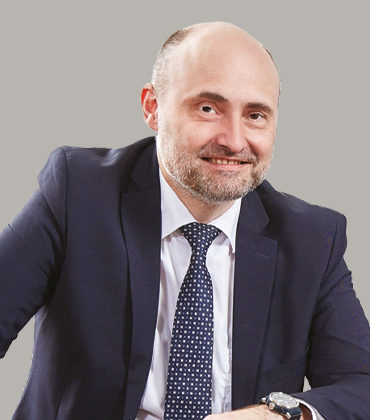 Robert Koppensteiner, Executive Vice President
Most machine builders start with the machine; GFM, a global leader in high‑precision manufacturing technology, starts with the technology.
When GFM was founded in 1945, its goal was not to manufacture equipment but to define a process. That process—radial forging—remains the sole focus eight decades later. An 80 percent market share in hot radial forging machines reflects how completely it has mastered this single discipline.
“It’s really in our genes,” says Robert Koppensteiner, EVP. “We always start from the technology. Then we build the machine around it.”
Before GFM engineers a solution, it understands the material, challenges of grain refinement and porosity evolution. Tooling design, heating and forming parameters are developed together. The machine is the last step, not the first.
Controlling Deformation at the System Level
How does GFM control deformation differently compared to conventional open-die forging methods?
In conventional open-die forging, force is applied from one or two directions. At GFM, typically four tools operate simultaneously in a single plane, working the material from all sides at once. Performance is defined by how precisely those tools move and how the process is executed for each material and geometry.
The challenge in any forging process is the cross-section. The outside of a workpiece deforms readily. The centre is more difficult to deform. Getting uniform strain from surface to core is where most processes fall short. GFM’s hydro-mechanical drive addresses this directly; unlike conventional hydraulic systems, it allows fine, independent adjustment of stroke behaviour, deformation and contact time for each stage of the forging sequence, keeping interactions between tool and material short and controlled. Surface chilling is prevented. Strain penetrates consistently towards the core.
What It Means in Production
Why do GFM systems deliver higher output, efficiency, and material performance in production environments?
The RX series quantum-leaps in deformation control, furthering it through a direct-drive concept based on torque motors. Customers have documented a 60 percent reduction in centreline voids compared to previous generations, with improved mechanical properties throughout. Greater dimensional accuracy significantly reduces machining allowance. For producers of high-value alloys, that yield improvement alone saves millions of euros per year. RX systems consume approximately 40 percent less power than comparable pure-hydraulic-driven machines.
One example: A conventional press line produces 15,000 to 20,000 railroad axles per year. A GFM machine produces up to 120,000. One customer replaced three conventional hammers in non-magnetic drill collar production with a single GFM machine, tripling output. A French tube producer replaced three rolling mills with a single radial forging line, improving dimensional accuracy and cutting operational costs. Customers transitioning from conventional systems report output increases of two to five times, with corresponding reductions in energy consumption, tooling costs and staffing requirements.
The Software Behind the Machine
In what way does software integration enhance control, automation, and lifecycle performance of machines?
A real-time CNC system with a 0.5ms internal cycle time sits at the centre of GFM’s digital ecosystem. The BarForge CAM system automatically generates forging pass sequences. The FemForge digital twin runs finite element analysis in the background, supporting continuous process optimisation. Together, they enable lights-off production and fully autonomous forging lines, where operators monitor rather than execute. Integration extends to MES and ERP systems. GFM supports each machine throughout its full service life, typically spanning several decades.
The Argument for Total Cost
“Companies that invest in this level of technology perform well even in difficult market conditions,” says Koppensteiner. “Those that focus only on capital expenditure tend to fail when markets become more challenging.”
GFM machines are not low-cost. What they deliver across decades of production, in output, material yield, energy savings and consistency, is the calculation that matters. Eight decades of market share confirm it. GFM supplies radial forging machines in all sizes for accurate cold forging applications, as well as for hot forging of large ingots and remelts.
Company
GFM (Gesellschaft für Fertigungstechnik und Maschinenbau)
Management
Robert Koppensteiner, Executive Vice President
Description
GFM (Gesellschaft für Fertigungstechnik und Maschinenbau) designs advanced radial forging systems that control deformation at the process level. With decades of specialisation, the company enables high-precision metal forming, delivering superior material integrity, consistency and efficiency across demanding industrial applications worldwide.


Manufacturing Technology Insights Weekly Brief
Be first to read the latest tech news, Industry Leader's Insights, and CIO interviews of medium and large enterprises exclusively from Manufacturing Technology Insights
